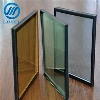

Tempered glass is made by cutting annealed glass to the required size, then heating it to around 700°C, close to its softening point, and rapidly cooling it to create uniform strength. (For example, 5-6mm thickness float glass takes about 240 seconds to heat up at 700°C and 150 seconds to cool down. For 8-10mm float glass, it takes about 500 seconds to heat and 300 seconds to cool. The time varies depending on the glass thickness). After tempering, the surface of the glass forms compressive stress, while the inside undergoes tensile stress, improving the glass's bending and impact resistance. Its strength is typically more than four times that of regular annealed glass. Once tempered, the glass cannot be cut, ground, or processed further, as doing so would disrupt the balanced compressive stress, causing the glass to shatter into small pieces.
Advantages of tempered glass


Safety: When tempered glass breaks, it shatters into small, blunt-edged pieces resembling a honeycomb structure, reducing the risk of serious injury.
High Strength: Tempered glass has 3 to 5 times higher impact strength and bending strength than regular glass of the same thickness.
Thermal Stability: Tempered glass is highly thermally stable and can withstand a temperature difference of up to 300°C, about three times that of ordinary glass.


disadvantage of tempered glass
Tempered glass cannot be cut or processed after tempering; any adjustments must be made before the tempering process.
While stronger than standard float glass, tempered glass can spontaneously break (called "spontaneous breakage"), which doesn't happen with float glass.
The surface of tempered glass may have slight irregularities (called "waves" or "distortion"), and it can become slightly thinner after tempering. This thinning occurs because the glass is rapidly cooled after softening, which compacts the internal structure, increasing pressure. For instance, 4-6mm glass may become 0.2-0.8mm thinner, and 8-20mm glass may shrink by 0.9-1.8mm. This is why tempered glass cannot be polished into a mirror finish.
Types of Tempered Glass
By shape
Tempered glass comes in flat and curved varieties. Flat tempered glass typically comes in thicknesses of 11, 12, 15, 19mm, while curved tempered glass can be 11, 15, or 19mm thick, with variations depending on the manufacturer's equipment and technology. Curved tempered glass (bent glass) has a maximum radius limitation (R), with the radius being the half-radius of the curve. Tempered glass is classified into two grades based on its flatness: premium (used for automotive windshields) and standard (used for architectural decoration).


By Process:
There are two main types of tempered glass based on the manufacturing process:
Physical Tempered Glass: This is the more common method. Ordinary flat glass is heated close to its softening point (around 600°C), and then quickly cooled by spraying high-pressure cold air on both sides. This creates compressive stress on the surface and tensile stress inside, making the glass stronger. If damaged, the glass breaks into small, blunt pieces.
Chemical Tempered Glass: This process uses ion exchange to improve the glass's surface strength. The glass is immersed in molten lithium (Li+) salts, which replace sodium (Na+) or potassium (K+) ions on the surface, creating compressive stress. This results in a similar internal tensile and external compressive stress as physical tempering, making it equally strong.
By Tempering Strength
Normal Tempered Glass: Tempering strength = 2-4N/cm. For curtain walls, the surface stress is ≥ 95MPa.
Semi-tempered Glass: Tempering strength = 2N/cm. Surface stress is between 24MPa and 69MPa.
Super-tempered Glass: Tempering strength > 4N/cm.
Applications of tempered glass
Tempered glass, both flat and curved, is considered safety glass and is widely used in various industries. Some of the most common applications include:
- Construction and Architecture: Used in windows, curtain walls, and interior partitions.
- Furniture Manufacturing: Glass coffee tables, shelving, and furniture components.
- Home Appliances: Tempered glass is used in items like TVs, ovens, air conditioners, and refrigerators.
- Electronics and Instruments: For devices like smartphones, MP3 players, MP4 players, and clocks.
- Automotive Industry: For car windshields, side windows, etc.
- Daily Use Products: Tempered glass is used for things like cutting boards.
- Specialty Industries: Military-grade glass for specialized applications.
Because tempered glass breaks into small, blunt pieces without sharp edges, it's often referred to as "safety glass," making it ideal for use in cars, high-rise buildings, and other safety-critical areas.
Applications

glass partitions

glass shelves

glass coffee tables

car windshields

tempered glass window

shower door

curtain wall

building glass
Conclusion
Tempered glass is a type of safety glass that is strengthened through either physical or chemical processes. Its performance is enhanced by creating a difference in stress between the inner and outer layers. In the physical process, the glass is heated to its softening point and then rapidly cooled, while in the chemical process, ions on the surface are replaced through ion exchange. Both methods result in a glass strength 3 to 5 times greater than that of regular glass, with thermal stability allowing it to withstand temperature differences of up to 300°C. When broken, tempered glass shatters into small, blunt-edged pieces, ensuring high safety.
However, tempered glass has some limitations, including its inability to be reprocessed, the risk of spontaneous breakage, and the potential for surface distortion and thinning (which prevents it from being polished into a mirror finish). It is classified by shape into flat and curved types, by process into physical and chemical types, and by tempering strength into three categories: regular, semi-tempered, and super-tempered.
Tempered glass is widely used in construction (e.g., curtain walls and windows in high-rise buildings), automotive windshields, furniture, appliances, and electronic devices. As a core material that balances safety and strength, tempered glass holds an irreplaceable position in both industrial and civilian applications.
We are here for you
With excellent quality and detail-oriented service, Laurel Glass will be your best partner for glass materials and solutions.