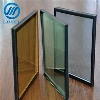


In recent years, with advancements in high-performance laminated glass materials, DG41 (Saflex DG) and SGP (SentryGlass Plus) have emerged as leading choices in architectural and structural glazing applications.
While both offer superior strength and safety compared to standard PVB interlayers, they differ significantly in performance, temperature stability, applications, and cost.
This raises an important question:
Can DG41 replace SGP?
To answer this, we compare their key properties, structural behavior, and suitability for different environments.
1. Material Composition & Compatibility
DG41 (Saflex DG) is a high-strength PVB interlayer developed by Eastman. Unlike SGP, it can be combined with other Saflex PVB interlayers (such as RA, RB, and Vanceva), allowing for greater design flexibility and color options.
SGP (SentryGlass Plus) is an ionoplast-based interlayer by DuPont, originally developed for hurricane-resistant glazing in the U.S. It cannot be combined with other interlayers but offers unmatched rigidity and post-breakage performance.
2. Strength & Structural Performance
Shear Modulus & Rigidity:
SGP has a significantly higher shear modulus, meaning it remains stiff under load, even after glass breakage.
DG41, while stronger than standard PVB, loses stiffness at higher temperatures (above 30°C), making it less reliable in hot climates or structural applications.
Post-Breakage Safety:
SGP can sustain up to 400 kg for 45 minutes even after glass breakage, making it ideal for glass floors, balustrades, and overhead glazing.
DG41 is not recommended for high-load or high-temperature applications, as its strength drops when heated.
3. Temperature Stability
SGP performs consistently across a wide temperature range, making it suitable for both interior and exterior applications.
DG41 experiences a sharp decline in shear modulus above 30°C, limiting its use in warm climates or sun-exposed installations.
4. Applications
|
Feature
|
SGP (SentryGlass Plus)
|
DG41 (Saflex DG)
|
|
Best For
|
High-load, safety-critical applications (glass floors, stairs, canopies, balustrade, hurricane-resistant glazing, open edge laminates, curtain wall)
|
Aesthetic & moderate-load applications (interior partitions, decorative glass, balustrade, open edge laminates)
|
|
Temperature Resistance
|
Excellent (stable up to high temps)
|
Poor (weakens above 30°C)
|
|
Post-Breakage Strength
|
Extremely high (holds 400kg+)
|
Limited (not for safety barriers)
|
|
Compatibility
|
Cannot be combined with other interlayers
|
Can be layered with other PVB interlayers (Vanceva, RA, RB)
|
|
Cost
|
Higher
|
More affordable
|
5. Cost Considerations
SGP is more expensive but justified in high-safety applications.
DG41 is a cost-effective alternative for projects where extreme strength and temperature resistance are not critical.
Conclusion: Can DG41 Replace SGP?

While DG41 offers advantages in design flexibility and cost, it cannot fully replace SGP in high-performance applications.
Choose SGP for:
Structural glazing (glass floors, stairs, balconies)
Hurricane- and impact-resistant glass
High-temperature environments
Choose DG41 for:
Decorative and interior laminated glass
Projects requiring color combinations (Vanceva compatibility)
Lower-cost solutions where extreme strength is unnecessary
SGP remains the superior choice for safety-critical applications, while DG41 is better suited for aesthetic and moderate-performance uses. The two materials serve different purposes, and replacement depends entirely on project requirements.