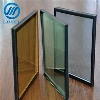

In modern architectural glass design, both ceramic fritted glass and digital printed glass are widely used to achieve aesthetics, privacy, and solar control. Although they may look similar at first glance, these two decorative glass solutions are produced using different technologies and serve slightly different design purposes. Understanding their differences helps architects, designers, and project developers choose the right glass for façades, curtain walls, skylights, and interior applications.
What is Ceramic Fritted Glass?
Ceramic fritted glass is produced by applying ceramic ink (frit) onto the glass surface before or during a heat treatment process such as tempering or heat strengthening. The ceramic particles are fused into the glass surface at high temperatures, forming a permanent and durable finish.
This process creates patterns such as dots, lines, gradients, or custom textures that become an integral part of the glass itself.
Because the ceramic frit is baked into the surface, it offers excellent long-term stability and resistance to fading, scratching, UV exposure, and weathering. This makes it especially suitable for exterior architectural applications where durability is essential.
Ceramic fritted glass is often used to reduce solar heat gain, improve bird-friendly building design, and enhance privacy without fully blocking natural light.


What is Digital Printed Glass?
Digital printed glass is manufactured using advanced digital ceramic printing technology, where high-resolution images, patterns, or graphics are directly printed onto the glass surface using specialized ceramic inks. Unlike traditional screen printing, digital printing does not require physical screens or fixed patterns, allowing unlimited design flexibility. Architects can create gradient effects, photographic images, branding elements, or complex artistic visuals with high precision. After printing, the glass is typically tempered or heat strengthened so that the ceramic inks fuse permanently into the surface, ensuring durability and weather resistance.
Digital printed glass is commonly used in modern architecture for decorative façades, corporate branding buildings, interior partitions, and customized design projects that require high visual impact.


Key Differences Between Ceramic Fritted Glass and Digital Printed Glass
Although both products use ceramic-based inks and heat treatment processes, their production methods and design capabilities are significantly different.
Ceramic fritted glass is generally based on repetitive patterns such as dots, grids, or linear designs. It is ideal for functional performance such as shading, privacy control, and glare reduction. The design is usually more standardized and controlled by mesh or roller-based application methods. Digital printed glass focuses on high-definition customization. It supports full-color graphics, gradients, images, and complex visual storytelling. This makes it more suitable for architectural identity, branding, and creative façade design.
From a production perspective, ceramic fritted glass is more efficient for large-scale uniform projects, while digital printed glass is more flexible for small-batch, customized, or visually complex applications.
Applications in Modern Architecture
Ceramic fritted glass is commonly used in curtain walls, skylights, balcony railings, and building façades where solar control, privacy, and safety are important. It is also widely applied in bird-friendly building designs to reduce collision risks.
Digital printed glass is frequently used in commercial buildings, airports, shopping malls, office interiors, and cultural architecture where visual identity and creative expression are key priorities. It is especially popular for feature walls, branding façades, and decorative partitions.


At Laurel Glass, we provide advanced ceramic fritted glass and digital printed glass solutions tailored for global architectural projects. With high-precision equipment and experienced production capability, we support both large-scale façade projects and fully customized design requirements.
Our glass solutions can be integrated with tempered, laminated, or insulated glass systems to meet different safety, energy efficiency, and structural needs.